Good yoga studio mirrors do two jobs. They let students check their alignment without breaking focus, and they let you, the instructor, see the whole room at a glance. Get the size, height, and placement right and the mirror wall quietly does its job every class.
Get it wrong, and you end up with mirrors hung too high to see a seated pose, or a wall that pulls students' attention to how they look instead of how they feel. Here's how to choose, place, and budget for a mirror wall that works.
Short answer: For most yoga studios, go with frameless 1/4-inch glass with a safety backing, mounted across the front wall the class faces. Start it 0 to 16 inches off the floor so students can see themselves on the mat. A 24-foot front wall takes six 4' × 6' panels hung vertically.
Why Yoga Studios Use Mirrors

- Alignment checks. Students can see whether their hips are square in warrior II or their shoulders are stacked in a plank, then adjust on their own.
- A view of the whole class. From the front of the room, you can watch the back row in the mirror without turning around or walking the floor.
- Clearer demos. When you face the mirror with the class, students see your demo from the front and the back at the same time.
- A brighter, bigger-feeling room. A full mirror wall bounces light around and makes a small studio feel more open.
What the Research Says About Mirrors in Yoga
Mirrors help with form, but they come with a trade-off worth knowing about. In a University of Minnesota study of women in yoga classes, students who practiced in a mirrored room compared their appearance to others more, and they left class with higher body-image anxiety than students in a room without mirrors.
That doesn't mean you should skip mirrors. It means you should use them on purpose. University of Minnesota researchers who studied yoga and body image suggest that studios with mirrors encourage students to use them for checking alignment and give them ways to avoid negative thoughts about how they look.
In practice, that can look like this:
- Cue the mirror for specific things, like "check that your front knee is over your ankle," not as a general "look at yourself."
- Give students a break from it. Turn the class to face a side or back wall for restorative work, meditation, or savasana.
- Consider curtains. Some studios add a curtain track so the mirror can be covered for classes that don't need it.
For a deeper look at the studies on mirrors and exercise, see why you need a mirror for exercise.
What to Look for in Yoga Studio Mirrors
- Frameless glass, not acrylic or tiles. Acrylic flexes and can make the reflection look wavy, and tiles break it up at every seam. Glass gives students a true picture of their alignment. Here's our comparison of mirror types.
- 1/4-inch (6mm) thickness. It stays flat on the wall and gives a clear reflection across a long run of panels.
- A safety backing film. If the glass is ever hit, the film holds it together so it webs instead of dropping shards on a floor where people practice barefoot. More on why shatter-resistant mirrors matter.
- Flat-polished edges. They look clean without a frame, and panels sit side by side as one continuous wall.
- Mechanical mounting. Skip glue. Our standard install sets each mirror in a bottom J-channel (a metal track along the bottom edge) and secures the top with clips.
Where to Put Mirrors in a Yoga Studio

Most yoga studios put the mirror on the front wall, the one the class faces, and run it the full width of the room. A few other things matter just as much:
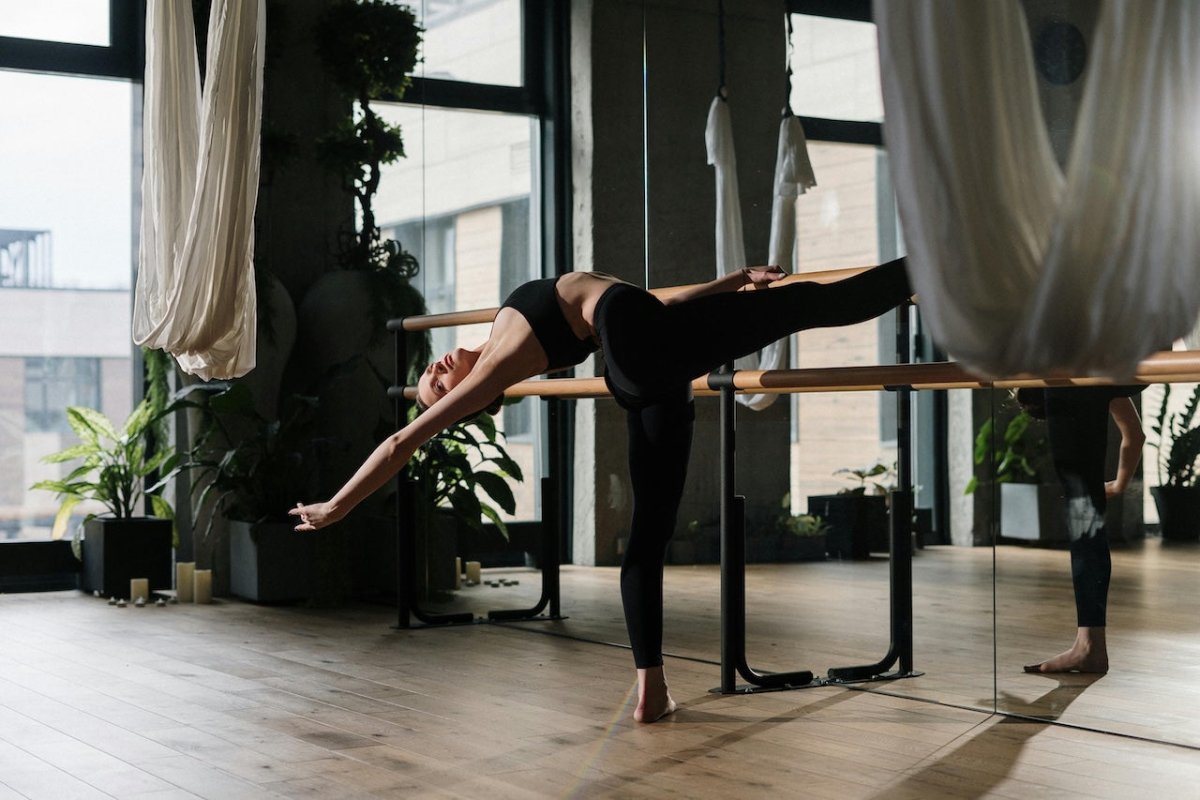
- Mount it low. So much of yoga happens on the mat: seated twists, kneeling poses, tabletop, lying down. Start the mirror 0 to 16 inches off the floor, not at eye level, so students can still see themselves when they're down low.
- Go tall, too. 4' × 6' panels hung vertically cover standing poses with arms overhead for most people.
- Add a side wall if you teach alignment-heavy classes. A mirror on an adjacent wall gives students a profile view in poses like downward dog.
- Leave room in front. Set the first row of mats far enough back that nobody can kick or knock the glass during a standing split or a wobbly balance pose.
- Mind the lighting. Soft, even light looks best in a mirror. A mirror across from windows spreads daylight deeper into the room, while bright spotlights aimed at the glass can bounce glare back at students.
- Plan around outlets and thermostats. If a panel has to cover an outlet, we can cut an opening for it.
What a Yoga Studio Mirror Wall Costs
Each 4' × 6' mirror is $344.99, plus $75 for professional installation, so $419.99 per panel installed on drywall. For a 24-foot front wall, that's six panels for $2,519.94. A 3' × 5' panel is $274.99, or $349.99 installed, if you're working with a smaller wall.
Concrete, block, and brick walls add $50 per mirror, and outlet cutouts are $150 each. We deliver and install within 100 miles of our 8 metro hubs, usually within 3 to 10 days. For a studio, choose the Commercial project type in our builder, or call us for a free quote on larger jobs. Studios and gyms including Club Pilates, YWCA, Anytime Fitness, and Snap Fitness have trusted us with their mirrors.
Yoga Studio Mirror FAQs
Do yoga studios need mirrors?
No, and some styles teach without them. But mirrors make it easier for students to check alignment and for instructors to see the whole class, which is why most studios have at least one mirrored wall.
How high should yoga studio mirrors be mounted?
Start them 0 to 16 inches off the floor. Students spend a lot of class seated, kneeling, or lying down, and a mirror mounted at eye level misses all of that.
What size mirrors work best for a yoga studio?
4' × 6' panels hung vertically and lined up across the front wall. They're tall enough for standing poses and low enough for floor work.
Are glass mirrors safe in a yoga studio?
Ours have a safety backing film that holds the glass together if it's hit, so it webs instead of breaking into loose shards. That matters in a room where people practice barefoot.
Can I put a yoga mirror at home?
Yes. One 4' × 6' panel behind your mat is enough for most home practice. Here are our tips for home yoga and Pilates mirrors.
Planning a Studio Mirror Wall?
Build your mirror wall online and pick your install date at checkout, or call us for a studio quote. We'll deliver it and hang it, usually within 3 to 10 days. Customers rate us 4.99 out of 5 across 650+ reviews.
Build Your Mirror WallQuestions? Give us a call at (651) 615-4234 or email info@mirrorsdelivered.com, 9:00 AM to 5:00 PM CST.